
US President Donald Trump has issued a stern 48 hour ultimatum to Iran, warning that failure to fully reopen the Strait of Hormuz without any threats to navigation will trigger devastating US strikes on Iranian power plants. In a post on Truth Social late Saturday evening, Trump declared that if Tehran does not comply within the tight deadline, the United States will hit and obliterate various power plants, starting with the biggest one first.
The announcement marks a sharp escalation in the ongoing conflict involving the United States, Israel, and Iran, now in its fourth week. The Strait of Hormuz, a critical chokepoint for global oil trade through which roughly one fifth of the worlds oil supply passes daily, has faced severe disruptions amid the war. Iran has restricted or threatened shipping, particularly vessels linked to what it calls its enemies, leading to skyrocketing energy prices and international concern over supply chain stability.
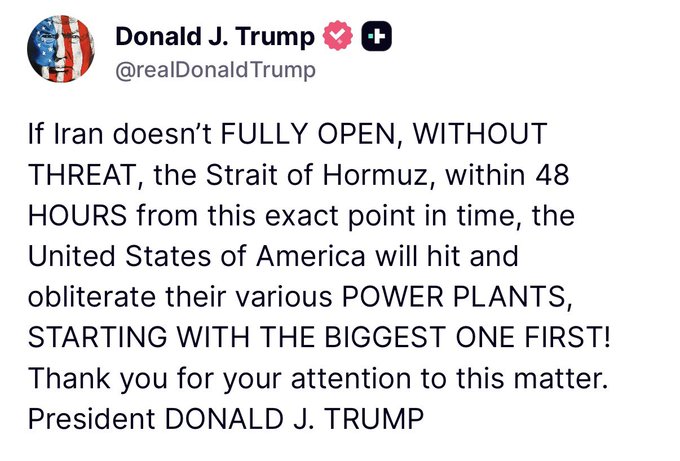
Trumps message came just a day after he had spoken of winding down the conflict, making this pivot particularly striking. From his Mar a Lago residence in Florida, the president emphasized unrestricted and threat free passage, framing the demand as non negotiable to protect global commerce and US interests. The ultimatum adds intense pressure on Tehran at a time when US forces, including Marines and naval assets, continue deploying to the region, and recent strikes have already targeted Iranian coastal missile sites and infrastructure to degrade threats to the strait.
In response, Iranian officials and the Islamic Revolutionary Guard Corps have vowed retaliation, stating that any attack on Irans energy facilities would lead to targeting all US energy infrastructure across the region. This tit for tat rhetoric heightens fears of broader escalation, potentially drawing in more actors and further destabilizing Middle East security.
The development has drawn immediate global attention, with analysts warning of severe economic repercussions if the strait remains restricted or if military action disrupts power generation in Iran. As the 48 hour clock ticks, world leaders and markets watch closely for Tehrans next move, amid calls for diplomacy to avert a wider crisis in one of the most volatile regions.


